Cheap Chinese AI: A Boon or a Risk for French SMEs?
Key takeaway
Chinese open-source AI models provide SMEs with technical capabilities equivalent to US leaders at a fraction of the cost, with the added security of local hosting.

Quentin
An American entrepreneur, speaking under the cover of anonymity, recently cut his annual software bill by $400,000. How? By replacing American AI systems with Qwen, the open-source model from Chinese giant Alibaba. Global statistics confirm this rapid shift: the share of Chinese models in AI queries rose from 1.2% in late 2024 to over 30% today, according to a report from OpenRouter and Andreessen Horowitz.
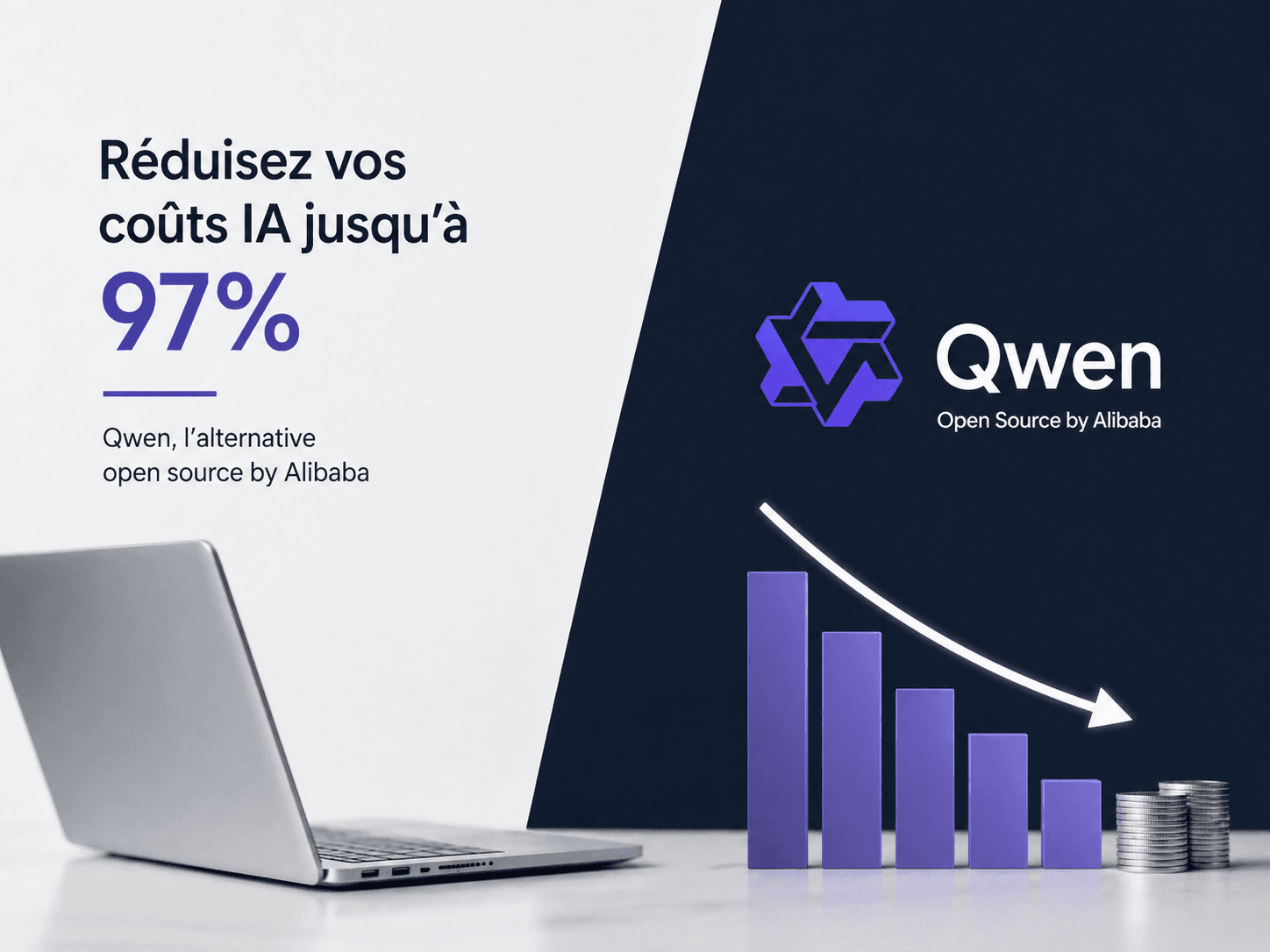
Media attention remains focused on announcements from OpenAI and Google, but a purely financial reality is asserting itself for businesses. State-of-the-art models like DeepSeek V4 or R1 offer technical capabilities that rival the best Western standards for a price up to 97% lower. For a French SME with limited investment budgets, this price gap completely reshapes the digital equation. The calculation is no longer whether AI is a luxury, but how to deploy these economic engines without compromising the security of internal processes.
90% of SME Tasks Do Not Justify Overpriced AI
DeepSeek V4 Flash processes one million tokens for just a few cents. In comparison, American leaders demand budgets ten to twenty times higher to perform strictly identical tasks. The Chinese company goes even further by billing its cached memory queries at a tenth of their initial price.
This aggressive pricing highlights a often-ignored fact: the vast majority of business uses are administrative or operational in nature. Drafting a series of product descriptions, extracting data from a fifty-page PDF, or categorizing thousands of customer support tickets does not require the global general knowledge embedded in Silicon Valley's most massive models. Alternatives like Qwen or Z.ai (GLM) excel in these routine operations. An SME has no financial interest in paying for an AI capable of solving complex mathematical theorems when it needs to sort supplier invoices. The lighter Chinese models provide the exact precision required by these processes, making the return on investment measurable almost immediately.
Algorithmic Efficiency Born from Hardware Constraints
DeepSeek researchers trained their flagship model on a massive volume of 33 trillion tokens using throttled Nvidia GPUs. US sanctions, designed to deprive China of raw computing power, produced an unexpected side effect: they forced extreme optimization engineering.
Deprived of the hardware firepower of their competitors, Chinese labs had to drastically refine the efficiency of their algorithms. The result is seen in the V4 Pro architecture, which activates only 49 billion parameters out of a total of 1.6 trillion during a specific query. This resource economy allows the models to run quickly on standard servers without requiring massive infrastructure. For mid-sized companies, this technical feat ensures that it is possible to obtain an advanced level of reasoning without paying the premium associated with using the world's most expensive data centers. Experience shows that the technical directors we support at Olixid naturally gravitate toward these solutions when they realize that operational performance remains intact despite the drop in infrastructure costs.
Data Sovereignty via Local Hosting
Mark Barton, head of the firm Omniux, is hesitant to deploy Chinese technologies for his clients due to fears of sanctions or information leaks. Entrusting a customer database or financial information to an API managed from Beijing triggers an immediate red flag for any decision-maker concerned with GDPR.
This security tension disappears thanks to the distribution format of these tools. Unlike the dominant American products that lock the user into a closed ecosystem, the leading Chinese models are distributed with open weights. You download the engine and install it on the machines of your choice. Paul Triolo of DGA-Albright Stonebridge Group emphasizes that data security becomes a non-issue as soon as a company runs the model on its own equipment, without any outside connection. Researchers from Stanford University support this position, stating that open code remains the only true guarantee for thorough technical scrutiny. A French company can thus deploy Qwen on a private server located in Roubaix or Paris, ensuring total isolation for its strategic data.
Unlocking the Deployment of Autonomous Agents
To date, only 10.7% of French SMEs have integrated an AI solution into production. Bpifrance statistics also indicate that executives spend only four hours per week on their forward-looking strategy. In this context, AI often remains confined to writing emails or meeting summaries—a usage perceived as a simple minor gadget.
The real productivity leap lies in autonomous agents: programs capable of independently executing a logical sequence of tasks without constant supervision. However, running a complex agent on an American model is extremely expensive, as each iteration consumes tokens billed at a high price. The one-million-token context window offered by DeepSeek, combined with its microscopic inference costs, finally makes these agents viable for small structures. It becomes possible to build a software assistant that reads a customer's entire history, analyzes their latest contract, cross-references this data with the price catalog, and prepares a quote without risking a budget explosion at the end of the month. During the technical testing phases we supervise at Olixid, the integration of these open models removes the budgetary obstacle, allowing teams to move from the experimental stage to full and sustainable automation of their document workflows.
The AI market has split in two. The race for pure power continues among tech giants, but a mature, radically cheaper, and auditable alternative is now fully exploitable. For SMEs, the challenge is changing in nature: it is no longer about finding the budget to pay for machine access, but about investing time to integrate these free technologies into actual business processes.

Go from reading to doing
You've just read how AI transforms SMEs. The real question is: where do you start with yours? Our expert consultants help you identify the first opportunities in 30 minutes.
30 min · Free · No commitment
Written by
Quentin